
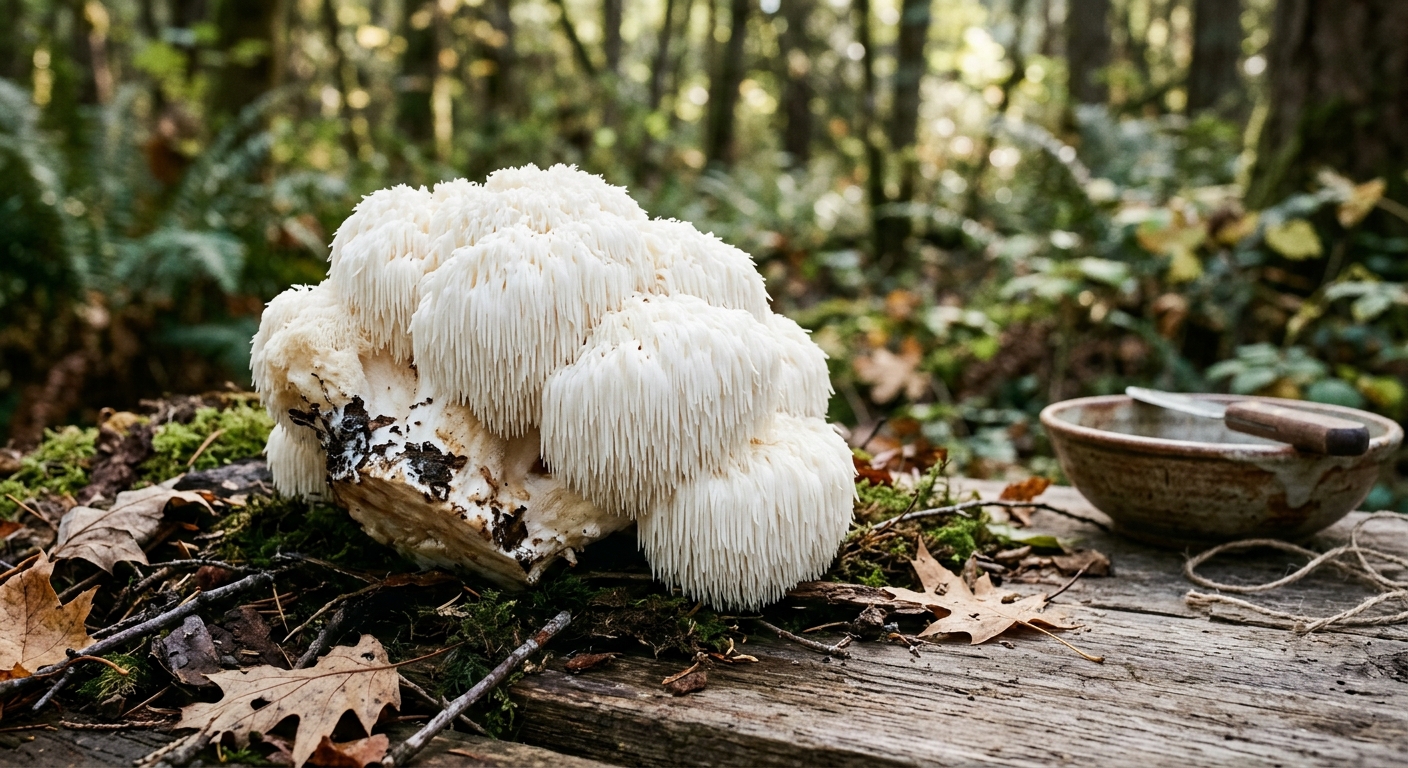
What does the evidence really say?
Lion’s Mane mushroom has become one of the better-known ingredients in the modern nootropics world.
Its scientific name is Hericium erinaceus, and it is an edible mushroom used as food and in traditional practices.
You may have seen claims that Lion’s Mane can “boost the brain”, improve memory, or support nerve growth.
Some of those claims come from interesting laboratory research. But I think it’s important to separate that research from what has actually been demonstrated in humans.
So let’s look at what we know.
What Is Lion’s Mane?
Lion’s Mane is a distinctive white mushroom with long, hanging spines that give it its name.
Scientists have identified compounds in the mushroom, including hericenones and erinacines, that have attracted interest in laboratory research.
This has led researchers to investigate whether Lion’s Mane might influence processes involved in the nervous system.
But there’s an important distinction:
A biological effect observed in a laboratory doesn’t automatically mean that eating a supplement will produce the same effect in people.
That’s a principle I want Suppliwell readers to remember when evaluating any supplement.
Why Is It Being Studied?
Researchers have been interested in Lion’s Mane partly because of its potential effects on pathways involved in nerve growth and nervous-system function.
A lot of this early work has involved cells or animals.
That’s useful for generating scientific questions.
But when I’m deciding how much confidence to place in a health claim, I put much more weight on well-designed human clinical trials.
And this is where the Lion’s Mane evidence becomes more interesting—but also more limited.
What Have Human Studies Found?
One of the better-known clinical trials was published in 2009.
Researchers conducted a double-blind, placebo-controlled trial involving 30 adults aged 50–80 with mild cognitive impairment.
Participants took either Lion’s Mane or placebo for 16 weeks.
The researchers reported significantly higher cognitive-function scores in the Lion’s Mane group at weeks 8, 12 and 16 compared with placebo. However, the improvement decreased after participants stopped taking the mushroom.
That’s an interesting finding.
But it’s also a small study, with only 30 participants.
So I wouldn’t use that study alone to claim that Lion’s Mane improves memory in everyone.
Another Human Study
A later randomized, double-blind, placebo-controlled study investigated Lion’s Mane supplementation for 12 weeks and reported improvements in some cognitive measures. The researchers themselves noted that evidence for human health effects remained uncertain.
Again, this is worth investigating.
It doesn’t give us enough evidence to call Lion’s Mane a proven cognitive enhancer.
What About Healthy Younger Adults?
More recent research has started looking at shorter-term effects in healthy younger people too.
A 2025 randomized, double-blind, placebo-controlled crossover study included 18 healthy adults aged 18–35 and examined cognitive and mood outcomes following a standardized Lion’s Mane extract.
This type of research is useful because it asks a different question from studies involving people with mild cognitive impairment.
But one small study in 18 people isn’t enough to establish a reliable long-term cognitive benefit.
So, Does Lion’s Mane Improve Memory?
My answer is:
We don’t know yet with enough confidence.
Human studies suggest possible cognitive benefits, including research in people with mild cognitive impairment.
But the evidence base remains relatively small, and studies have differed in their participants, preparations, doses, and outcomes.
That makes it difficult to say exactly:
“Lion’s Mane improves memory.”
I’d consider that claim too strong based on the evidence currently available.
What About Nerve Growth?
This is where you’ll often see some very impressive claims online.
You’ll hear about NGF — nerve growth factor — and Lion’s Mane’s potential influence on it.
There is genuine scientific interest here.
However, much of the evidence behind these mechanisms comes from laboratory and preclinical research.
So I wouldn’t take a laboratory finding and turn it into a promise about what a Lion’s Mane supplement will do inside a human brain.
Interesting mechanism ≠ proven human benefit.
That’s one of the most important distinctions in supplement research.
What About Mood?
Researchers have also investigated possible effects on mood and psychological wellbeing.
There are some early human findings worth exploring, but the evidence isn’t strong enough for me to recommend Lion’s Mane as a treatment for depression, anxiety, or another mental-health condition.
If someone is experiencing persistent changes in mood, they should seek appropriate professional support rather than relying on a supplement.
Is Lion’s Mane Safe?
The human trials available so far have generally reported Lion’s Mane as well tolerated over the study periods.
For example, the 2009 clinical trial reported no adverse effects in its laboratory testing.
However, that doesn’t mean every Lion’s Mane product is automatically safe for every person.
Possible issues can include:
- Digestive discomfort
- Allergic reactions
- Differences between mushroom preparations
- Unknown effects from long-term use
- Interactions with medicines or health conditions
The product itself also matters.
A mushroom powder, fruiting-body extract, and concentrated extract aren’t necessarily equivalent products.
Why Product Quality Matters
When I look at supplement research, I always want to know what participants actually received.
That’s particularly important with Lion’s Mane.
A study using one particular extract doesn’t automatically prove that every Lion’s Mane powder or capsule on the market produces the same result.
So when reading a product claim, I would ask:
What type of Lion’s Mane was studied?
How much was used?
For how long?
Was it tested in humans?
Was there a placebo group?
Those questions can tell us much more than a marketing headline.
My Suppliwell Evidence Assessment
🧠 Evidence for cognitive benefits: Emerging
Human clinical trials show promising findings, but the evidence base is still too limited and inconsistent for strong claims.
🔬 Laboratory evidence: Interesting
There is substantial scientific interest in mechanisms involving nerve cells and neurotrophic pathways, but laboratory findings shouldn’t be treated as proof of human benefits.
👥 Human evidence: Limited but promising
Human studies exist, including randomized controlled trials, but they have generally been relatively small.
⏳ Long-term evidence: Limited
We need more high-quality, larger, and longer human trials.
My Suppliwell Takeaway
I find Lion’s Mane genuinely interesting.
There is enough human research for me to think it deserves further investigation, but not enough for me to describe it as a miracle brain supplement.
The most responsible way I can describe the current evidence is:
Lion’s Mane is a promising area of research, but its cognitive benefits in humans have not been firmly established.
That’s very different from saying it doesn’t work.
It means we need better evidence.
And that’s exactly why I’ll keep watching the research.
Before You Try It
I wouldn’t recommend starting a supplement simply because you’ve seen an impressive claim online.
If you’re considering Lion’s Mane, think about:
- What are you hoping it will do?
- Is there good human evidence for that particular outcome?
- What product and preparation are you considering?
- Are you taking medication?
- Do you have allergies or an existing health condition?
- Could you discuss it with a healthcare professional?
And remember:
A supplement shouldn’t replace sleep, physical activity, good nutrition or appropriate medical care.
Quick Summary
| Question | Suppliwell assessment |
|---|---|
| Is Lion’s Mane a real mushroom? | Yes |
| Has it been studied in humans? | Yes |
| Is there evidence of possible cognitive effects? | Yes, but limited |
| Is it proven to boost memory in healthy people? | No |
| Is the laboratory research interesting? | Yes |
| Is it a proven treatment for dementia? | No |
| Do we need more research? | Definitely |
Important Note
This article is educational and isn’t intended to diagnose, treat, cure or prevent disease. If you’re experiencing significant changes in memory, thinking, mood or neurological function, seek advice from an appropriately qualified healthcare professional.
References
Mori K, et al. (2009). Improving effects of the mushroom Yamabushitake (Hericium erinaceus) on mild cognitive impairment: a double-blind placebo-controlled clinical trial. Phytotherapy Research, 23(3), 367–372.
Saitsu Y, et al. (2019). Improvement of cognitive functions by oral intake of Hericium erinaceus. Biomedical Research, 40(3), 125–131.
Recent randomized controlled research (2025). Acute effects of a standardized extract of Hericium erinaceus on cognition and mood in healthy younger adults.
Want to understand more about brain health?
Download the free Suppliwell Brain Health Handbook.