
A closer look at the evidence for cognition, inflammation and brain health
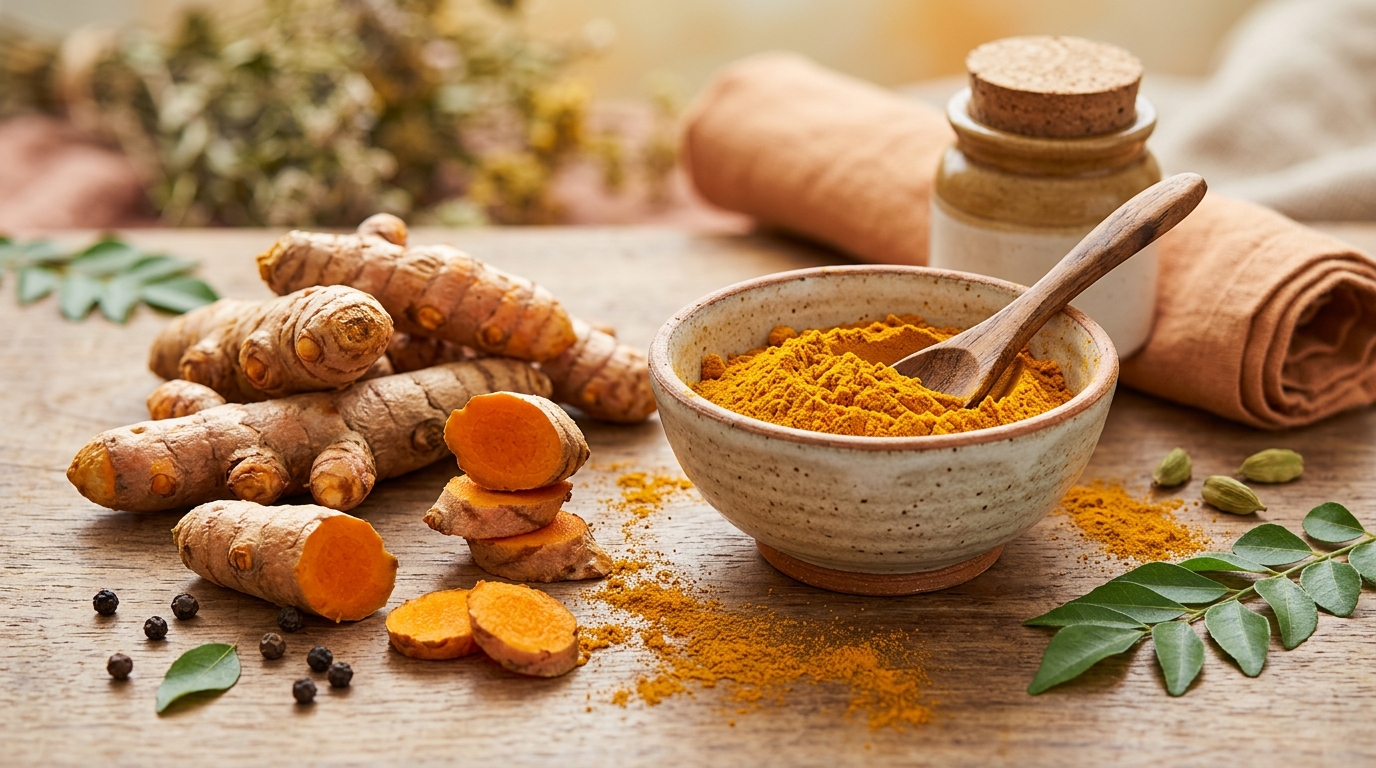
Turmeric is probably one of the most familiar ingredients on our list.
It’s been used in cooking and traditional medicine for a very long time, and modern research has focused heavily on one group of compounds found in turmeric: curcuminoids, particularly curcumin.
You’ll find curcumin marketed for everything from inflammation and joint health to memory and brain health.
Some of those claims are based on interesting research.
Others go considerably further than the evidence allows.
So, as with every Suppliwell ingredient, I want to separate the interesting science from established human evidence.
First: Turmeric Isn’t the Same as Curcumin
This distinction is important.
Turmeric is the plant material obtained from Curcuma longa.
Curcumin is one of the compounds found in turmeric.
Curcuminoids are a group of related compounds, with curcumin being the best-known.
So when a study says “curcumin,” we shouldn’t automatically assume that eating ordinary turmeric powder will produce the same result.
The preparation matters.
The dose matters.
And the way the curcumin is formulated matters.
Why Has Curcumin Attracted So Much Attention?
Curcumin has been investigated for its antioxidant and anti-inflammatory properties.
Laboratory research has produced a huge amount of interest in its potential biological effects.
That includes research involving pathways relevant to inflammation, oxidative stress and the nervous system.
But there’s a problem.
Curcumin is poorly absorbed in its conventional form.
Researchers have therefore developed different formulations intended to increase its bioavailability. Human pharmacokinetic research has demonstrated substantial differences between conventional curcumin and some enhanced-bioavailability formulations.
This becomes particularly important when we’re interpreting clinical studies.
What Does the Cognitive Research Show?
This is where things get interesting.
A 2025 systematic review and meta-analysis examined 9 randomized controlled trials involving 501 participants.
The researchers reported a statistically significant improvement in global cognitive function compared with placebo.
However, the authors also found that the effect appeared to depend on factors including treatment duration and participant characteristics. Benefits were particularly evident in trials lasting at least 24 weeks and in participants aged 60 or older.
That’s encouraging.
But there are some important caveats.
Nine trials and 501 participants isn’t a massive evidence base.
And the studies didn’t necessarily use identical curcumin products.
So I wouldn’t turn that result into:
“Curcumin prevents cognitive decline.”
The evidence doesn’t establish that.
What About Working Memory?
An earlier meta-analysis looked specifically at different cognitive domains.
It included 8 randomized controlled trials involving 389 participants.
The researchers found a statistically significant improvement in working memory with curcumin compared with placebo.
However, they didn’t find significant improvements in several other domains, including overall cognitive function, verbal memory, episodic memory and cognitive flexibility/problem solving.
This is a useful example of how important it is to define what we mean by “cognition.”
Memory isn’t one single thing.
And an improvement in one cognitive test doesn’t necessarily mean a person will experience a dramatic improvement in everyday memory.
Why Are the Results So Different Between Studies?
There are several possible reasons.
Different people
A study involving healthy older adults isn’t necessarily comparable with one involving people with cognitive impairment.
Different doses
The amount of curcumin used varies considerably between studies.
Different products
Standard curcumin and enhanced-bioavailability formulations aren’t necessarily equivalent.
Different durations
Some studies are short-term, while others run for several months.
Different cognitive tests
Researchers can measure memory, attention, processing speed, executive function and other outcomes separately.
This is one reason systematic reviews can produce apparently contradictory results.
Bioavailability: The Curcumin Problem
This is one of the most important sections of this article.
Conventional oral curcumin has poor bioavailability because it is poorly soluble and undergoes extensive metabolism.
Researchers have developed numerous formulations designed to improve absorption.
A review of human pharmacokinetic research identified multiple enhanced-bioavailability formulations, including formulations using different delivery technologies.
Another analysis of 165 randomized controlled trials found that researchers had used at least 25 different approaches to improve curcumin bioavailability, including piperine, phospholipid formulations, nanomicelles and other delivery systems.
That’s a huge variation.
And it means we have to be careful when someone says:
“Clinical studies prove curcumin works.”
The next question should be:
Which curcumin?
What Is Piperine?
You may see black pepper extract or piperine included in curcumin supplements.
One reason is that piperine can increase curcumin’s bioavailability.
It is one of the most commonly used approaches in clinical research.
But higher absorption isn’t automatically the same thing as a better health outcome.
Increasing exposure to a compound can also change its safety or interaction profile.
So I wouldn’t assume:
more absorption = better supplement.
The actual clinical outcome still needs to be demonstrated.
What About Alzheimer’s Disease?
This is an area where online claims can become particularly exaggerated.
You’ll often see curcumin discussed in relation to:
- Amyloid
- Tau
- Neuroinflammation
- Oxidative stress
- Alzheimer’s disease
There are interesting laboratory and animal findings.
But these shouldn’t be confused with proof that curcumin prevents or treats Alzheimer’s disease.
Reviews of the human evidence have described the clinical research as limited and inconsistent.
The National Center for Complementary and Integrative Health likewise notes that clinical research on turmeric/curcumin for disease prevention remains limited and that there isn’t sufficient evidence to recommend turmeric supplementation for preventing disease.
So:
Curcumin is not an established treatment for Alzheimer’s disease.
What About Inflammation?
Curcumin’s anti-inflammatory properties are one of the main reasons for its popularity.
There is biological evidence supporting anti-inflammatory activity, and clinical research has investigated curcumin for several inflammatory and pain-related conditions.
However, the NCCIH currently describes the evidence for turmeric supplementation in inflammatory disorders as insufficient to draw firm conclusions.
That’s an important distinction.
Biological activity is not the same as proven clinical benefit.
What About Mood?
Some clinical studies have investigated curcumin in relation to mood and psychological wellbeing.
There are promising findings in some populations, but this isn’t enough to present curcumin as a treatment for depression or another mental-health condition.
If someone has persistent or serious changes in mood, professional assessment is much more appropriate than relying on a supplement.
What About Safety?
This is an area where we need to pay particular attention to the formulation.
NCCIH states that conventional oral turmeric/curcumin is likely safe for most adults in recommended amounts for up to around 2–3 months, although gastrointestinal side effects can occur.
Reported gastrointestinal effects can include:
- Nausea
- Stomach upset
- Acid reflux
- Diarrhoea
- Constipation
But there is an additional issue with some high-bioavailability curcumin products.
Liver injury has been reported in some people using enhanced-bioavailability formulations.
This is one reason I don’t want Suppliwell to simply say:
“It’s natural, so it’s safe.”
Natural doesn’t automatically mean risk-free.
A Warning About Liver Symptoms
If someone taking a turmeric or curcumin supplement develops symptoms such as:
- Unusual fatigue
- Nausea
- Loss of appetite
- Dark urine
- Yellowing of the skin or eyes
they should stop the product and seek medical advice.
NCCIH specifically highlights these symptoms in relation to potential liver injury.
What About Pregnancy?
NCCIH notes that turmeric supplements may be unsafe during pregnancy, and there is limited information about amounts above those normally found in food during breastfeeding.
This is another reason to distinguish:
Turmeric used as a normal food ingredient
from
concentrated turmeric/curcumin supplements.
They aren’t necessarily equivalent from a safety perspective.
My Suppliwell Evidence Assessment
🧠 Cognitive function: Promising but emerging
Recent meta-analysis evidence suggests possible improvements in global cognition, while other analyses suggest benefits may be concentrated in particular cognitive domains such as working memory.
🧠 Working memory: Promising
An earlier meta-analysis found a statistically significant improvement, although more research is needed to establish the practical significance and consistency of the effect.
🧓 Cognitive ageing: Interesting but not established
Some trials suggest potential benefits in older adults, but the evidence isn’t sufficient to say curcumin prevents cognitive decline or dementia.
🔥 Inflammation: Promising but uncertain
There is substantial biological research, but clinical evidence varies by condition and remains insufficient for broad claims.
🧪 Bioavailability: Major consideration
Different formulations can produce dramatically different exposure levels, making it difficult to generalise results from one product to another.
🛡️ Safety: Generally reasonable short-term, but formulation matters
Conventional products appear reasonably well tolerated in the short term, but enhanced-bioavailability products have been associated with reports of liver injury.
My Suppliwell Takeaway
Curcumin may be one of the more scientifically interesting ingredients on our list.
There are human trials suggesting potential benefits for certain aspects of cognition, particularly working memory, and newer evidence is encouraging.
But I’m not prepared to call it a proven “brain booster.”
The research is complicated by differences in:
dose → formulation → absorption → treatment duration → participants → cognitive tests.
And that matters.
My conclusion is:
Curcumin shows promising evidence for certain aspects of cognitive function, but larger, standardised clinical trials are still needed before we can make strong claims about long-term brain-health benefits.
And there’s another lesson here that I think is extremely important for anyone buying supplements:
The ingredient name alone doesn’t tell the whole story.
Before You Try Turmeric or Curcumin
I’d ask:
- Am I looking at turmeric or a concentrated curcumin extract?
- What formulation is being used?
- Is bioavailability enhanced?
- What dose was actually studied?
- How long was the research conducted?
- Am I taking medication?
- Do I have a health condition?
- Could I speak with a pharmacist or healthcare professional first?
And I’d remember that turmeric as a normal food ingredient is very different from taking a concentrated supplement.
Quick Summary
| Question | Suppliwell assessment |
|---|---|
| Is turmeric the same as curcumin? | No |
| Has curcumin been studied in humans? | Yes |
| Evidence for working memory? | Promising |
| Evidence for overall cognition? | Promising but emerging |
| Proven to prevent dementia? | No |
| Proven treatment for Alzheimer’s? | No |
| Anti-inflammatory biological activity? | Yes |
| Proven treatment for inflammatory disease? | Not established |
| Does formulation affect absorption? | Yes, substantially |
| Are conventional products generally tolerated short-term? | Generally yes |
| Can high-bioavailability products cause problems? | Potentially, including liver injury |
| Do we need more research? | Yes |
The Suppliwell Bottom Line
Turmeric and curcumin are a perfect example of why good supplement education requires more than repeating marketing claims.
There’s fascinating biology behind curcumin.
There are positive human studies.
There are also studies showing little or no benefit for particular outcomes.
And different formulations can behave very differently.
So rather than saying:
“Curcumin protects your brain.”
I’d say:
“Curcumin shows promising evidence for certain aspects of cognitive function, but the long-term brain-health benefits remain uncertain.”
That’s the evidence-based position I’m comfortable putting the Suppliwell name behind.
Important Note
This article is for general educational purposes and isn’t intended to diagnose, treat, cure or prevent disease. It isn’t a substitute for individual medical advice. If you have a medical condition, take medication, are pregnant or breastfeeding, or are considering concentrated turmeric/curcumin supplementation, speak with an appropriately qualified healthcare professional.
References
Zeng M, et al. (2025). The effect of curcumin supplementation on cognitive function: an updated systematic review and meta-analysis. Frontiers in Nutrition.
Effect of Curcumin Differs on Individual Cognitive Domains across Different Patient Populations: A Systematic Review and Meta-Analysis (2021).
Curcumin and Cognitive Function: A Systematic Review of the Effects of Curcumin on Adults With and Without Neurocognitive Disorders (2024).
Curcumin and Cognitive Health: Insights from Randomized Controlled Trials (2026).
Bioavailable curcumin formulations: A review of pharmacokinetic studies in healthy volunteers.
Bioavailability of Oral Curcumin in Systematic Reviews (2024).
NCCIH — Turmeric: Usefulness and Safety.
NCCIH — Nutritional Approaches for Musculoskeletal Pain and Inflammation.
Want to understand the bigger picture?
Explore the Suppliwell Nootropics A–Z library or download the free Brain Health Handbook.