
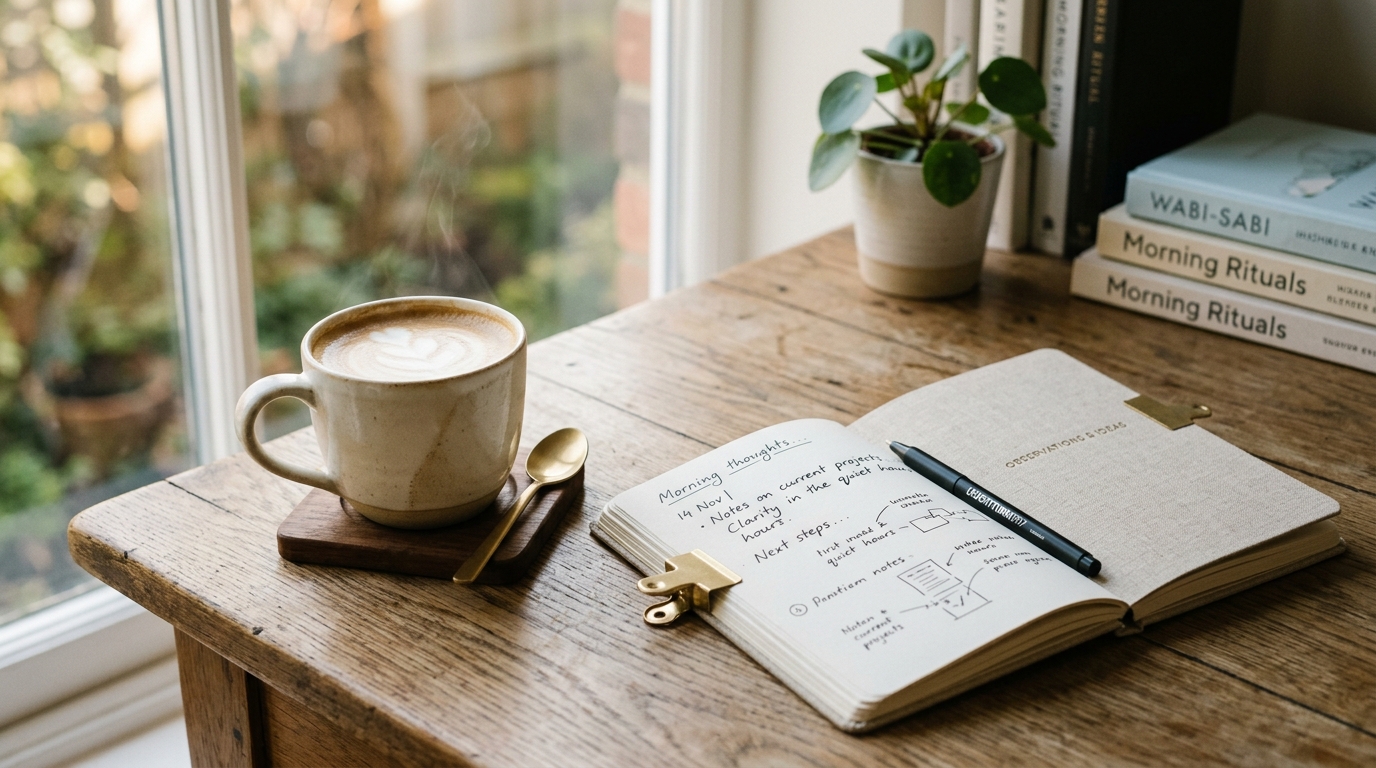
Caffeine
Your morning coffee may be doing more than waking you up
For millions of people, the day starts with the same ritual.
Coffee.
Maybe it’s one cup.
Maybe it’s two.
Maybe you don’t really feel human until you’ve had it.
Caffeine is the world’s most widely consumed psychoactive substance, and coffee is one of its most popular delivery systems.
Unlike many ingredients in the nootropics world, caffeine doesn’t have a mysterious reputation.
We already know it can make us feel more awake.
But there’s much more to the story.
Caffeine can affect:
- Alertness
- Attention
- Reaction time
- Perceived energy
- Exercise performance
- Mood
- Sleep
- Anxiety
- Tolerance
- Withdrawal
And perhaps the most important question for everyday coffee drinkers isn’t:
“Is caffeine good or bad?”
It’s:
“How do I use caffeine without letting it interfere with the things that matter more?”
Especially sleep.
Let’s look at the evidence.
What Is Caffeine?
Caffeine is a naturally occurring compound found in plants including:
- Coffee
- Tea
- Cocoa
- Guarana
- Yerba mate
It can also be added to foods, drinks, supplements, and medications.
Caffeine’s main action in the brain involves blocking adenosine receptors.
Adenosine builds up during wakefulness and drives sleep pressure.
By blocking adenosine’s effects, caffeine can reduce tiredness and increase alertness.
That’s why coffee can make you feel like you’ve suddenly switched the lights back on.
But there’s an important distinction:
Caffeine can reduce your perception of fatigue without necessarily removing the underlying need for sleep.
Why Does Coffee Wake You Up?
Throughout the day, adenosine gradually accumulates in the brain.
As adenosine activity increases, we become progressively sleepier.
Caffeine competes with adenosine at certain receptors.
The result can be:
Less perceived sleepiness → greater alertness → increased ability to stay awake.
This is one reason caffeine can be particularly useful when you’re tired.
But it also explains one of caffeine’s biggest limitations.
Eventually:
You still need sleep.
Caffeine cannot permanently override biology.
Does Caffeine Actually Improve Focus?
Yes — this is one of the better-supported effects.
Caffeine can improve alertness and aspects of attention, particularly when someone is tired or sleep-deprived.
It can also improve reaction time and vigilance.
But the size of the effect varies depending on:
- Dose
- Habitual caffeine consumption
- Time of day
- Sleep status
- Individual sensitivity
- Genetics
This is why one person can drink an espresso and feel highly stimulated while another can drink coffee after dinner and fall asleep normally.
There is no single caffeine response.
What About Memory?
This is more complicated.
Caffeine clearly affects alertness.
But improved alertness doesn’t automatically mean improved memory.
Some studies have found improvements in memory consolidation or specific memory tasks, while others have found little or no effect.
In everyday life, the practical benefit may therefore be more about:
Being awake enough to pay attention in the first place.
If you’re struggling to concentrate because you’re exhausted, caffeine may help you engage with the task.
That’s different from saying caffeine inherently improves your memory.
What About Reaction Time?
This is one area where caffeine has relatively consistent effects.
Caffeine can improve:
- Vigilance
- Reaction speed
- Alertness
- Psychomotor performance
These effects are particularly useful when you’re tired.
This is one reason caffeine has become so popular in:
- Driving
- Shift work
- Exercise
- Studying
- Long working sessions
But again, caffeine isn’t a substitute for adequate sleep.
Does Caffeine Make You More Productive?
It can make some tasks feel easier.
But there’s an important distinction between:
feeling more energetic
and
actually producing better work.
If you’re tired, caffeine may increase alertness and help you stay engaged.
But consuming more caffeine doesn’t necessarily produce proportionally more productivity.
Eventually, too much stimulation can work against you.
You may become:
- Jittery
- Distracted
- Anxious
- Restless
- Unable to sit still
- Less precise
The goal isn’t maximum stimulation.
It’s useful alertness.
How Much Caffeine Is in Coffee?
This is where coffee drinkers can get caught out.
There’s no universal caffeine content for “a cup of coffee.”
It varies depending on:
- Bean type
- Roast
- Brewing method
- Serving size
- Brand
- Strength
The FDA notes that regular brewed coffee can contain roughly 113–247 mg of caffeine per 12-fluid-ounce serving in the products considered in its consumer guidance.
That’s a huge range.
So:
“I only drink two coffees.”
doesn’t tell us how much caffeine someone actually consumes.
Two small, weak coffees are very different from two large, strong coffees.
How Much Caffeine Is Too Much?
For most healthy adults, EFSA concludes that total caffeine intake of up to 400 mg per day, spread throughout the day, does not raise safety concerns. It also considers single doses up to 200 mg generally safe for healthy adults.
The FDA similarly cites 400 mg per day as an amount not generally associated with negative effects for most adults, while emphasizing that individual sensitivity varies.
But here’s the important bit:
400 mg isn’t a target.
It’s better understood as a general safety reference for healthy adults.
You don’t need to consume 400 mg simply because you can.
If 150 mg gives you the alertness you want without affecting your sleep, there’s little reason to push higher.
What Happens If You Have Too Much?
The symptoms are usually pretty recognizable.
You might experience:
- Jitters
- Restlessness
- Anxiety
- Rapid heartbeat
- Palpitations
- Headache
- Nausea
- Upset stomach
- Difficulty sleeping
The FDA specifically highlights increased heart rate, palpitations, high blood pressure, insomnia, anxiety, jitters, nausea and headache among possible effects of excessive caffeine.
And some people experience these effects at much lower doses than others.
Why Does Caffeine Affect People Differently?
There are several reasons.
Genetics
People differ genetically in how quickly they metabolize caffeine and how sensitive they are to its effects.
Body size
A given dose can produce a different exposure depending on body weight.
Medications
Some medications can affect caffeine metabolism or sensitivity.
Habitual consumption
Regular caffeine users can develop tolerance.
Sleep
Someone who is severely sleep-deprived may experience caffeine very differently from someone who is well-rested.
Timing
A morning coffee and a late-evening coffee aren’t physiologically equivalent.
Caffeine Tolerance
This is something everyday coffee drinkers often notice.
Your first coffee might once have felt like:
“Wow.”
After years of drinking coffee, it might simply feel like:
“I’m normal again.”
That’s tolerance.
With regular caffeine consumption, some noticeable effects can weaken.
This can lead people to increase their intake.
Two cups become three.
Three become four.
Eventually, they may not actually be chasing a stronger effect.
They may simply be trying to avoid withdrawal.
Caffeine Withdrawal
Caffeine withdrawal is real.
If you regularly consume caffeine and suddenly stop, you may experience:
- Headache
- Fatigue
- Sleepiness
- Difficulty concentrating
- Irritability
- Low mood
The symptoms can be unpleasant, but they are usually temporary.
This is one reason people sometimes say:
“Coffee gives me energy.”
When part of the effect may actually be:
“Coffee removes the withdrawal symptoms I developed from drinking coffee regularly.”
That doesn’t mean caffeine provides no genuine benefit.
It means tolerance changes the experience.
Should You Take a Break From Caffeine?
There’s no universal requirement to cycle caffeine.
If you’re drinking moderate amounts and feel good, there’s no established need to periodically “detox” from caffeine.
However, reducing caffeine can sometimes be useful if:
- You need increasingly large amounts
- You feel dependent on it
- You’re experiencing anxiety or jitters
- Your sleep is suffering
- You’re drinking caffeine throughout the entire day
If you want to reduce your intake, gradually cutting down is often more comfortable than suddenly stopping.
The Biggest Caffeine Mistake: Ignoring Sleep
This is probably the most important section in this entire article.
You drink coffee because you’re tired.
It works.
You feel better.
Then you drink another coffee later.
And another.
Eventually you go to bed.
But the caffeine is still active in your system.
You sleep less effectively.
The next morning you’re tired again.
So you drink more coffee.
And the cycle continues.
This is where caffeine can become counterproductive.
How Much Can Caffeine Affect Sleep?
A 2023 systematic review and meta-analysis of 24 studies found that caffeine reduced total sleep time by approximately 45 minutes, reduced sleep efficiency, and increased the time needed to fall asleep. It also reduced deep sleep.
That’s significant.
And a newer 2025 meta-analysis also found reductions in total sleep time, sleep efficiency, and slow-wave sleep, with increased sleep-onset latency.
The message is simple:
Caffeine can interfere with sleep even when you don’t realize it.
“But I Can Fall Asleep After Coffee”
This is where things get interesting.
Falling asleep doesn’t necessarily mean caffeine didn’t affect your sleep.
A 2024 randomized crossover study found that 400 mg of caffeine could disrupt sleep when taken even 12 hours before bedtime.
Participants didn’t necessarily perceive all of the objective changes in their sleep.
In other words:
You may think your coffee isn’t affecting your sleep when it actually is.
That’s important.
How Late Is Too Late for Coffee?
No single cutoff works for everyone.
But research provides useful guidance.
A 2023 meta-analysis estimated that a typical coffee containing about 107 mg of caffeine should be consumed roughly 9 hours before bedtime to avoid reducing total sleep time.
That’s earlier than many people expect.
For a 10:00 pm bedtime, that would put the theoretical cutoff around:
1:00 pm.
However, this isn’t a universal rule.
Some people metabolize caffeine faster.
Others are much more sensitive.
And the amount matters.
A small morning coffee is very different from a large 400 mg dose in the afternoon.
A Practical Coffee Rule
Rather than obsessing over an exact cutoff, I’d use this:
If your sleep is good, your current caffeine timing may be fine.
If your sleep isn’t good, experiment with moving your last caffeine earlier.
Try:
No caffeine after lunch.
Do that consistently for a week or two.
Then see whether your sleep changes.
That’s a much more useful experiment than simply assuming caffeine isn’t affecting you because you can fall asleep.
What About Decaf?
Decaf isn’t necessarily caffeine-free.
It typically contains much less caffeine than regular coffee, but small amounts can remain.
That makes it a useful option for people who enjoy the:
taste + ritual + social experience
of coffee without wanting as much caffeine.
Is Coffee Healthy?
This is where we need to distinguish:
coffee
from
caffeine.
Coffee contains hundreds or thousands of compounds besides caffeine.
Therefore, research showing an association between coffee consumption and health outcomes doesn’t necessarily prove that caffeine caused the effect.
The FDA has also noted this distinction in its safety assessments.
This is why I wouldn’t automatically translate:
“Coffee is associated with X.”
into:
“Caffeine causes X.”
They’re not the same thing.
What About Coffee and Longevity?
Large observational studies have often linked moderate coffee consumption to various favorable health outcomes.
But observational research has limitations.
Coffee drinkers differ from non-coffee drinkers in many other ways.
So we shouldn’t claim that coffee itself guarantees better health or longer life.
For Suppliwell, the more defensible position is:
Moderate coffee consumption can fit comfortably within a healthy lifestyle for most adults, but coffee should not be treated as a medicine.
Caffeine and Exercise
Caffeine is also well established as an exercise-performance aid.
It can improve:
- Alertness
- Perceived effort
- Endurance performance
- Certain aspects of strength and power
This is one reason caffeine appears in many pre-workout products.
But if you’re an everyday coffee drinker, you don’t necessarily need a specialist pre-workout product to obtain caffeine.
Your morning coffee already provides it.
What About L-Theanine + Caffeine?
We’ve already covered L-theanine in Article 008.
But it’s worth connecting the two articles.
Research into L-theanine + caffeine suggests the combination may improve certain measures of attention and mood compared with placebo.
A 2025 systematic review and meta-analysis found small-to-moderate differences favoring the combination on some measures during the first two hours after consumption, although the researchers emphasized uncertainty and the need for more research in real-world settings.
This is one reason tea is so interesting.
Tea naturally contains:
Caffeine + L-theanine + polyphenols
But that doesn’t mean everyone should start adding L-theanine to their coffee.
The combination is promising.
It’s just not magic.
Is More Caffeine Better?
Definitely not.
Once you’ve reached the amount that gives you useful alertness, increasing the dose may simply increase unwanted effects.
You might get:
More stimulation
but also:
More anxiety
More heart pounding
More restlessness
Worse sleep
And worse sleep can create a need for even more caffeine the following day.
That’s not a particularly good nootropic strategy.
What About Energy Drinks?
Energy drinks can make caffeine consumption less obvious.
A coffee might feel like a drink.
An energy drink can sometimes feel like something completely different.
But your body doesn’t care about the marketing.
Caffeine is caffeine.
The FDA specifically recommends considering caffeine from all sources, including coffee, tea, energy drinks, supplements and medications.
If you drink coffee in the morning and an energy drink in the afternoon, both count toward your total.
Avoid Pure Caffeine Powder
This deserves a strong warning.
Highly concentrated caffeine products can be extremely dangerous because tiny measuring errors can result in very large doses.
The FDA specifically warns consumers against pure or highly concentrated caffeine powders and liquids.
For an everyday coffee drinker, there’s absolutely no sensible reason to use pure caffeine powder.
Coffee, tea and properly formulated products provide much more manageable amounts.
What About Pregnancy?
Caffeine intake requires additional caution during pregnancy.
EFSA considers habitual caffeine intake of up to 200 mg per day from all sources not to raise safety concerns for the foetus in the general population.
Anyone who is pregnant, trying to become pregnant or breastfeeding should discuss their individual caffeine intake with an appropriate healthcare professional.
What About Children?
Caffeine isn’t something we should casually recommend to children.
The FDA notes concerns around caffeine-containing energy drinks in children and teenagers, including effects on heart rate, blood pressure, anxiety and sleep.
Suppliwell’s adult-focused nootropics guidance shouldn’t be interpreted as a recommendation for children to consume caffeine.
My Suppliwell Coffee Strategy
If you’re an everyday coffee drinker, I’d keep it simple.
☕ Step 1 — Know your intake
Don’t just count cups.
Look at the approximate caffeine content.
🌅 Step 2 — Use caffeine when you actually need it
Morning caffeine can be useful.
You don’t necessarily need caffeine constantly throughout the day.
🕐 Step 3 — Protect your sleep
If sleep isn’t great, move your final caffeine earlier.
📉 Step 4 — Don’t automatically increase the dose
If two coffees work, three aren’t necessarily better.
🔄 Step 5 — Watch for tolerance
If coffee no longer feels stimulating but you feel terrible without it, tolerance may be part of the picture.
🧠 Step 6 — Remember what caffeine is doing
It’s primarily helping you feel more alert.
It isn’t replacing sleep, nutrition, exercise, or recovery.
My Suppliwell Evidence Assessment
⚡ Alertness: Strong evidence
This is caffeine’s clearest cognitive effect.
🎯 Attention/vigilance: Strong evidence
Caffeine can improve alertness and aspects of attention, especially when tired.
🏃 Exercise performance: Strong evidence
Caffeine is well established as an ergogenic aid.
🧠 Memory: Mixed
Some studies find benefits in particular circumstances; caffeine’s effects on memory are less consistent than its effects on alertness.
😴 Sleep: Strong evidence of disruption when timing/dose are unfavorable
Caffeine can reduce sleep duration, efficiency, and deep sleep.
🧘 Anxiety/jitters: Dose- and person-dependent
Some people tolerate caffeine extremely well.
Others become anxious or jittery at relatively low doses.
🔄 Tolerance: Real
Regular consumption can reduce some of caffeine’s noticeable effects.
🛡️ Safety: Generally favorable at moderate intake for healthy adults
EFSA and FDA guidance broadly support up to around 400 mg/day for most healthy adults, while individual sensitivity varies.
My Suppliwell Takeaway
Caffeine is probably the most successful nootropic ever created.
And we didn’t even have to invent it.
It was already sitting in coffee beans and tea leaves.
Its biggest strength is also its biggest weakness.
It works.
Caffeine can make you more alert.
It can improve vigilance.
It can help you feel less tired.
It can improve certain aspects of physical and cognitive performance.
But if you use it carelessly, you can create another problem:
Poor sleep.
And poor sleep can undermine almost everything you’re trying to achieve with a nootropic.
So my advice to the everyday coffee drinker is simple:
Use caffeine to support your day — not to compensate for a lack of sleep.
You don’t need to give up coffee.
You don’t need to fear caffeine.
You simply need to understand dose, timing, and your own response.
The Suppliwell Coffee Rule
If you remember only one thing from this article, make it this:
Enjoy your coffee. Respect your sleep.
That’s probably a better long-term strategy than chasing ever-higher caffeine doses.
Quick Summary
| Question | Suppliwell assessment |
|---|---|
| Does caffeine increase alertness? | Yes — strong evidence |
| Can it improve attention? | Yes |
| Can it improve reaction time? | Yes |
| Does it always improve memory? | No |
| Can it improve exercise performance? | Yes |
| Does tolerance develop? | Yes |
| Can withdrawal cause headaches/fatigue? | Yes |
| Can caffeine disrupt sleep? | Definitely |
| Is 400 mg/day a target? | No |
| Is up to 400 mg/day generally considered safe for most healthy adults? | Yes |
| Is less sometimes better? | Absolutely |
| Does coffee contain more than caffeine? | Yes |
| Can caffeine affect people differently? | Very much so |
| Should caffeine replace sleep? | Absolutely not |
The Suppliwell Bottom Line
Caffeine isn’t a miracle substance.
It doesn’t need to be.
It’s a well-studied compound that can reliably increase alertness and wakefulness, with useful effects on attention and performance.
For most healthy adults, moderate intake can comfortably fit into a healthy lifestyle.
But the smartest caffeine user isn’t necessarily the person drinking the most.
It’s the person who gets the benefit without sacrificing sleep.
So:
Coffee can help you wake up. Sleep is what actually helps you recover.
And that distinction is at the heart of sensible nootropic use.
Evidence first. Marketing second.
Important Note
This article is for general educational purposes and isn’t intended to diagnose, treat, cure, or prevent disease. It isn’t a substitute for individual medical advice. Caffeine affects people differently. If you have a medical condition, take medication, are pregnant or breastfeeding, or experience significant palpitations, anxiety, sleep problems or other symptoms after caffeine, speak with an appropriately qualified healthcare professional.
References
EFSA — Caffeine safety assessment. Guidance on daily and single-dose caffeine intake for healthy adults and pregnancy.
U.S. FDA — Spilling the Beans: How Much Caffeine Is Too Much? Consumer guidance on caffeine, coffee, symptoms and individual sensitivity.
Gardiner C, et al. (2023). The effect of caffeine on subsequent sleep: a systematic review and meta-analysis. Sleep Medicine Reviews.
Dose and timing effects of caffeine on subsequent sleep: a randomized clinical crossover trial (2024). SLEEP.
Age- and dose-specific effects of caffeine on sleep: a meta-analysis of controlled crossover trials (2025).
Payne ER, et al. (2025). Effects of tea, L-theanine and L-theanine plus caffeine on cognition, sleep and mood: systematic review and meta-analysis.
U.S. FDA — Warning concerning pure and highly concentrated caffeine.
Your brain doesn’t need more hype. It needs better information.
Explore the complete Suppliwell Nootropics A–Z library to see what the evidence really says about the ingredients people use for cognitive health.
L-Theanine – Creatine – Bacopa